Blog
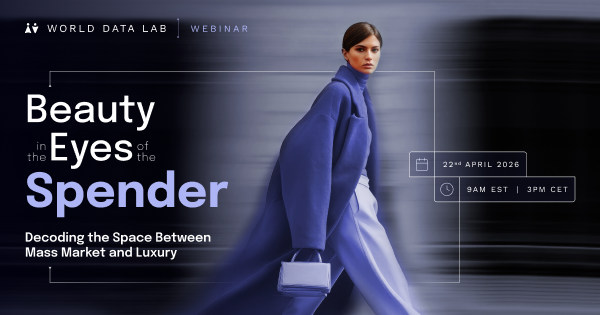

The global beauty market will hit $1 trillion by 2035, but the real question isn't how big it gets; it's who drives the growth. In World Data Lab's webinar Beauty in the Eyes of the Spender, analysts and industry experts unpacked the widening gap between mass-market and luxury spenders, and what it means for brands trying to win both.
Hosted by World Data Lab (WDL), NielsenIQ (NIQ), and Spate, the session moved beyond what consumers say to what they actually do with their money. Here's the data, the definitions, and the takeaways.
In 2026, the beauty product market, spanning skincare, haircare, hygiene, makeup, and fragrances, is worth $637 billion. It is projected to reach $1 trillion by 2035.
That growth curve is accelerating. It took 13 years to add the last $200 billion; it will take just 11 years to add the next $400 billion. Beauty is now a global category present in nearly every country, culture, and daily routine.
WDL's approach underpins these numbers: rather than relying on stated preferences, the firm models what consumers actually spend, refreshed four times a year across 194 countries and 7,000+ cities, broken down by age, generation, income group, city, and category.
Everyone spends on beauty, but not equally. WDL segments consumers by daily spending power:
| Segment | Daily spend | People | Beauty spend | Per capita |
|---|---|---|---|---|
| Poor & Vulnerable | Under $13/day | 3.42B | $30B | $15 |
| Core Middle | $13–$90/day | 4.09B | $314B | $115 |
| Affluent | $90+/day | 661M | $294B | $647 |
| Total | — | 8.16B | $637B | $78 |
The headline: affluent consumers spend 6× more per capita on beauty than the core middle. Beyond spending power, affluent and core consumers look structurally different:
| Characteristic | Core Middle | Affluent |
|---|---|---|
| Per-capita total spending | $8k | $54k |
| Aged 50+ | 30% | 45% |
| Average household size | 3.3 | 2.3 |
| In high-income economies | 22% | 71% |
| Urban | 76% | 91% |
Affluent consumers are older, more urban, live in smaller households, and are concentrated in high-income economies.
Most spending categories tilt toward one group. Food, beverages, and education skew toward the core; restaurants and financial services skew toward the affluent. Beauty is the rare category that sits almost perfectly in the middle, 54% core / 46% affluent spend in 2026.
That balance is shifting. Affluent beauty spending is set to overtake core spending at the tipping point in 2029, reaching 54% of total beauty spend by 2036. In several top markets, affluent consumers already lead.
Top 5 beauty markets — affluent share of spend:
| Country | 2026 spend | Affluent share (2026) | 2036 spend | Affluent share (2036) |
|---|---|---|---|---|
| USA | $141.6B | 84% | $217.4B | 88% |
| China | $95.3B | 15% | $172.9B | 26% |
| Japan | $25.1B | 43% | $37.8B | 51% |
| Germany | $24.5B | 58% | $33.4B | 64% |
| UK | $24.3B | 58% | $32.7B | 65% |
The US and UK are already affluent-led. By 2036, the pattern spreads, and even fast-growing China shifts meaningfully toward affluent spending.
As purchasing power rises, consumers unlock different products. WDL maps beauty against affordability thresholds, from a $13/day skin cream and a $20/day body wash, up to a $115/day high-end moisturizer and a $130/day luxury fragrance.
But affordability isn't destiny. The real story is discretionary choice. After essentials (food, housing, health, transport), the average affluent consumer has about $23,600 left to spend each year, versus just $3,100 for the core middle. Of that leftover, the average affluent consumer directs roughly $650 to beauty.
To separate mass from luxury, WDL uses a simple, robust marker: a bundle of 4–6 luxury beauty goods costs roughly $1,000. So the luxury beauty threshold is $1,000+ in annual beauty spend.
In 2026, 120 million people worldwide will spend more than $1,000 on beauty, while 4.63 billion mass-market consumers will not.
Crossing spending power with beauty spend produces four groups. These definitions are the analytical heart of the webinar:
Of the 120 million global luxury spenders, two-thirds are affluent, and one-third are core middle, proof that luxury beauty is not the exclusive domain of the wealthy.
Spain shows the pattern in miniature. Of ~47.6 million people, 2.2 million spend more than $1,000 on beauty (1.3 million of them affluent). Yet those luxury spenders, just 5% of the population, account for 33% of the country's $13.1 billion in beauty spending.
Within Spain's affluent luxury segment, spending is concentrated among female Baby Boomers and Gen X, who together account for over a third of the group. The overall gender split is 60% female / 40% male.
Affluent beauty spending will grow by $82 billion and by 123 million people through 2030. But growth looks very different by market.
China ranks #2 in both affluent beauty-spending growth (+$8B) and affluent population growth (+16M), behind the US on spend (+$26B) and India on population (+22M). What makes China distinctive is the type of growth versus the mature US market:
| Growth driver (2026–2030) | China | United States |
|---|---|---|
| Newly affluent consumers | 60% | 30% |
| Aged 45+ | 54% | 64% |
| Single-person households | 47% | 14% |
| Concentrated in top 10 cities | 25% | 26% |
China's growth is about expansion: new affluent consumers, older skewing, and cities beyond the top 10. US growth is about deepening — existing affluent consumers, especially the 45+ cohort, in larger households.
Bets for the future: among the world's top beauty capitals, São Paulo, Jakarta, and Hong Kong stand out as rising cities. São Paulo's growth is driven by older, affluent consumers; Jakarta's by younger, core-middle consumers — a reminder that city-level nuance matters as much as country totals.
The panel — Eric Mills (NielsenIQ), Yarden Horwitz (Spate), and Blandine Meyer (World Data Lab), moderated by Marco Fengler (World Data Lab) — translated the data into strategy.
Can a retailer serve both luxury and mass? Yes, but only through disciplined assortment. Luxury and mass overlap heavily; luxury shoppers also buy on TikTok Shop. The risk is trying to serve both and serving neither. Price elasticity varies by category, with fragrance far more elastic than skincare or personal care.
Is premiumization still the smart play? Yes, but "premiumization with a purpose," not just higher prices. What premiumization means varies by market: aspirational luxury-brand entry in Brazil and India, versus clinical, technology-led formulations in South Korea and China.
Is TikTok reshaping beauty? Massively. Mass-market brands are well-positioned, but luxury brands must adapt to TikTok Shop the way they eventually embraced Amazon, because affluent consumers are there too. Fragrance thrives on TikTok precisely because you can't smell it: influencer descriptions drive curiosity. The flip side is dupes, which ride the same attention.
Don't forget Gen X. While Gen Z reshapes trends, Gen X is the "forgotten generation" that shouldn't be forgotten again, highly willing to spend, active on TikTok Shop, and served by brands like Laura Geller working with Gen X creators around "mature skin." Eric Mills added that the menopausal beauty space (48 symptoms, many of which are skin- and hair-related) is significantly underserved worldwide.
Trends with staying power: red light therapy (including hair-growth devices), longevity and supplements, head spas, lip stains, and the matcha-adjacent aesthetic all have durability beyond a single viral moment.
How value is being redefined: beyond price, consumers now weigh efficacy (multifunctional products, derma brands, procedures), convenience (TikTok Shop, e-commerce leapfrogging in emerging markets), and emotion, the growing overlap of beauty with wellness, vitamins, and even sleep.
Anyone who spends more than $1,000 a year on beauty products, roughly the cost of a bundle of 4–6 luxury beauty goods. In 2026, 120 million people worldwide meet this threshold.
Aspirational luxury describes core-middle consumers who spend $1,000+ a year on beauty despite tighter means, either saving up or over-indexing their share of wallet on beauty. Roughly 40 million people fall into this group, and one-third of all luxury beauty spenders are core-middle rather than affluent.
Skincare is the dominant and fastest-growing category, accounting for around 60% of beauty spending, driven by a "skin-first" mindset, consumers investing in skincare in the hope of buying fewer cosmetics. Hybrid makeup-with-skincare products are a key emerging opportunity.
This analysis is powered by World Data Lab's consumer spending data, which models what people actually spend across 194 countries and 7,000+ cities, refreshed four times a year and broken down by age, generation, income group, city, and category. Leading companies — including L'Oréal, Shiseido, Beiersdorf, Colgate-Palmolive, Henkel, Tapestry, and Coca-Cola — use this data to move from country-level views to city-level, category-level, and addressable-consumer opportunities.
The webinar highlighted how three complementary lenses work together: World Data Lab identifies where growth and untapped consumers are located, NielsenIQ analyzes market- and brand-level trends, and Spate decodes how to reach those consumers through social platforms like TikTok.
Want to see where your next beauty consumers are? Get in touch with the World Data Lab team to explore the data behind these insights.